
How Big Can a 3D Infinity Dancefloor Be in the UK?
How Big Can a 3D Infinity Dancefloor Be in the UK?
“Bigger” isn’t just “more panels.” Once you scale up, the true limit is logistics: access routes, build windows, power planning, and whether the room can actually show the illusion properly.
Reality check: most venues suit 3m×3m to 6m×6m. 7m×7m+ becomes a mini-build. 8m×8m is possible, but rare — especially in Central London.
Quick Answer
The maximum size of a 3D Infinity Dancefloor in the UK is usually limited by access, build + test time, power distribution, and continuity/alignment — not just room dimensions. 8m×8m installs are rare because every constraint has to line up perfectly (especially in London).
- 📏 Size is logistics-led
- 🚚 Access route matters
- ⏱️ Test window is non-negotiable
- 🔌 Power needs zoning
- 🪞 Continuity keeps the illusion
What you’ll learn (quick summary)
This is the planner-grade version of “how big can we go?” — the real-world constraints that decide the maximum size before you lock your layout and schedule.
- 🧩 Panel scaling (what changes as you grow)
- 🪞 Continuity rules (why seams matter)
- 🚚 London access + load-in realities
- 🔌 Power + distribution planning
- ⏱️ Build + test time (hidden limiter)
- ✅ How to avoid last-minute downsizing
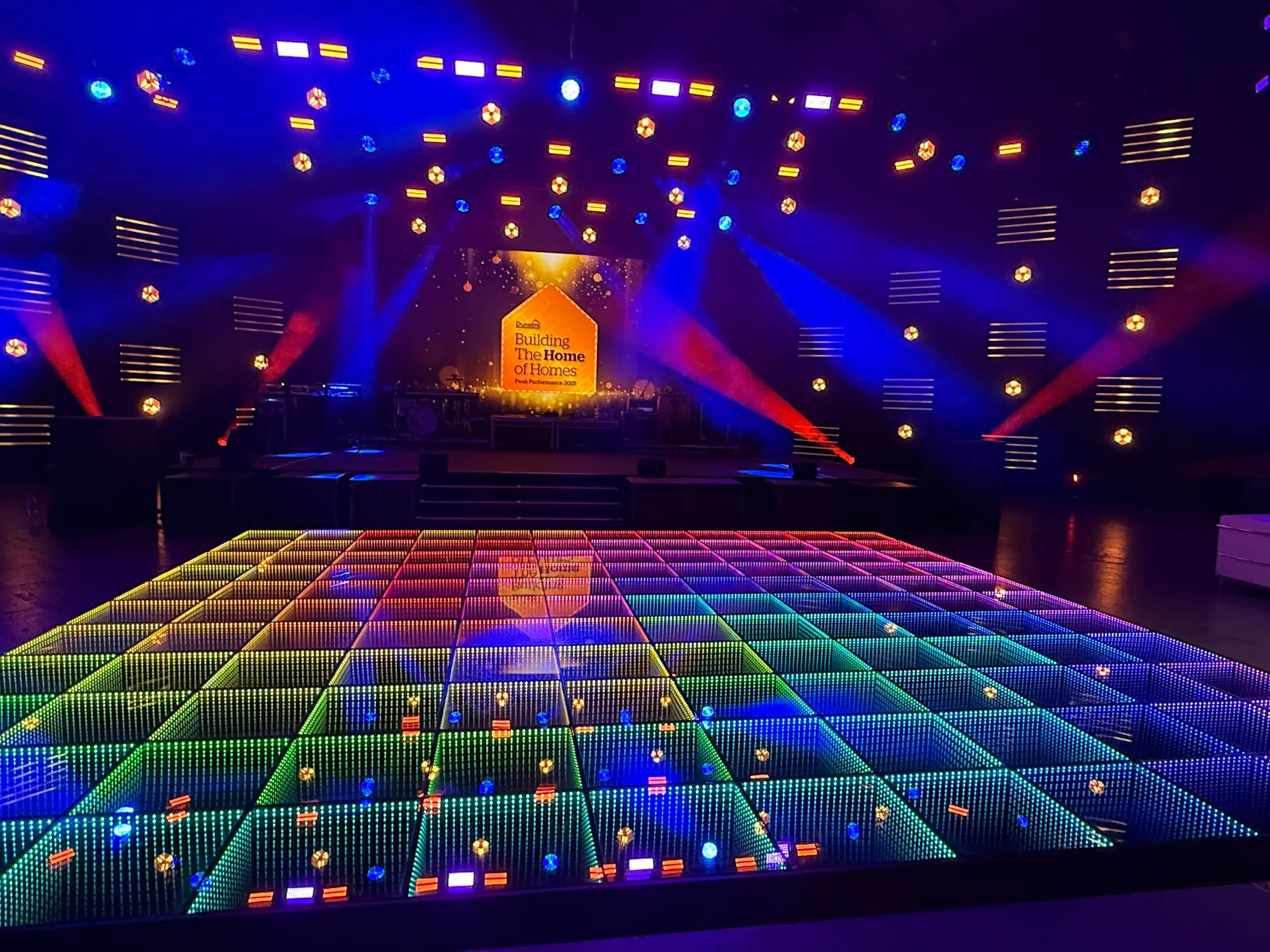
1) Panel Scaling 101 (What “Bigger” Actually Means)
A 3D Infinity Dancefloor scales by adding modular panels. Sounds easy — until you realise every extra row increases the complexity of alignment, cabling, and system testing.
More joints
More panels = more seams to align. Tiny misalignment shows more in wide shots.
More cabling
Routing grows with size. Cable management becomes part of the “finish”.
More test time
You want a protected window to test the whole system—before guests arrive.
More reliance on flatness
Bigger floors demand a flatter plane. Soft spots or slopes can break continuity.
2) Continuity Limits (The Illusion Has Rules)
The infinity effect depends on controlled reflections and clean geometry. When you go large, you’re fighting three enemies: sightlines, ambient light, and edge integrity.
A well-positioned 5m×5m with controlled lighting can look more premium than a 7m×7m squeezed into a compromised plan.
Start here if you want the baseline explainer: What Is an Infinity Dancefloor?
3) Why 8m × 8m Is Rare (Even When the Room Is Big)
People assume the blocker is floor area. In real life, the blocker is the route to get it there and the time window to build and test it.
- 🚚 Timed loading bays
- 🛗 Lift limits + long pushes
- ⏱️ Tight changeovers
- 🔌 Power procedures + sign-off
- 🧪 Protected test window required
“We can fit an 8×8” is meaningless unless you can also guarantee access, power, and build + test time.
4) London Venue Realities (The Practical Caps)
Central London venues often cap maximum size even when the ballroom is huge. Common constraints include timed loading slots, strict dock control, lift bookings, long internal pushes, and tighter build windows.
Timed load-ins
If your slot is short, large sizes become risky without extra crew and a locked plan.
Lift bottlenecks
One lift booked by multiple suppliers can slow everything. Sequencing matters.
Heritage rules
Protection, routes, and power procedures can add time (and reduce flexibility).
Room flips
If the room turns over from conference to dinner, your build window is often compressed.
London hub for context: Luxury Event Hire in London.
5) Power Planning Basics (Bigger Size = More Responsibility)
Large installs need power planned like a system: separate zones, clean routing, and headroom for DJ + audio + lighting. Even if the floor itself is efficient, the combined setup is what trips circuits.
| Risk point | What happens | What “good” looks like |
|---|---|---|
| Shared circuits | Floor + audio + lighting stacked on one ring | Dedicated zones with labelled distribution |
| No system test | Issues found when guests are in the room | Full test window for floor + audio + lighting |
| Messy routing | Trip hazards + visual clutter | Planned cable routes + ramps/tape where needed |
| Venue sign-off | Delays when power rules are strict | Power schedule confirmed early + compliance ready |
Venue constraints checklist: 15 Venue Questions Before Booking Entertainment.
6) Build & Test Timeline (The Hidden Limiter)
The bigger the floor, the more you need a realistic schedule: load-in, build, clean finish, then a protected system test. Without a proper test, you’re gambling on the moment you care about.
Load-in
Dock → corridors → lifts → room. This is where large sizes get slowed down.
Build
Panel alignment and finishing touches take longer at scale.
System test
Test the full setup together: floor, audio, lighting and mics.
Buffer
Keep margin for venue surprises. Margin is what makes it look “effortless”.
Want your venue’s max safe size?
Send venue + date + guest count + setup window — we’ll tell you the realistic maximum based on access, power and test time.
7) Decision-State Checklist (This Decides the Max Size)
Lock these early and your size becomes a decision — not a gamble.
- 🚚 Confirm access route + loading
- 🛗 Lift bookings + distance/push
- ⏱️ Protected build + test window
- 🔌 Power schedule + zones
- 📐 Flat floor / surface suitability
- 💡 Lighting plan to protect the illusion
If any of those are unclear, your “max size” is guesswork — and guesswork is how floors get downsized late.
8) UK Size Guide (What Works in Real Venues)
Use this as a planning baseline. Final size depends on access, build window and venue constraints — not just guest count.
| Floor size (m) | Best for | Why it works | Typical venue reality |
|---|---|---|---|
| 3×3 to 4×4 | Premium weddings, tighter rooms, fast turnarounds | Big visual impact with manageable build and access | Most hotel ballrooms + many London spaces |
| 5×5 to 6×6 | High-end weddings, corporate parties, brand events | “Hero feature” size without pushing logistics too far | Works widely with good load-in and a test window |
| 7×7 | Large-scale events with a strong production schedule | More time, tighter tolerances, heavier planning | More common in convention-style venues than Central London |
| 8×8 | Major launches, big productions, “mini-build” installs | Rare because access + crew + power + test must align | Achievable in the right venue; uncommon in London hotels/heritage rooms |
Mental model: once you go beyond 6×6, you’re not just “booking a dancefloor” — you’re scheduling a mini-build.
9) How to Spec a Large Infinity Floor (So It Doesn’t Get Downsized)
If you want a big floor, lock the constraints early — otherwise size gets cut in the final weeks when access or power realities show up.
- 1) Confirm access route (loading, lifts, distance)
- 2) Reserve build + test window
- 3) Get the venue power schedule early
- 4) Pick layout for sightlines (not just fit)
- 5) Align lighting so the illusion pops
Supporting reads (exact URLs): What Size Infinity Dancefloor Do I Need? and Infinity Dancefloor for Weddings vs Corporate Events.
How big can it be? FAQs
What’s the biggest 3D Infinity Dancefloor you can realistically install in the UK? 📏
The realistic maximum is the size you can build, cable, align and test within the venue’s access route and time window. Very large installs are achievable in the right venues, but rare because constraints stack quickly.
Why is 8m×8m so rare in Central London venues? 🚚
Timed loading bays, lift limits, long pushes, tight changeovers and stricter power procedures. Even with enough room inside, the route and the schedule often cap the maximum size.
Does a bigger floor always look better? 🪞
Not always. If sightlines are poor or room lighting is too bright, a larger floor can look flatter. A slightly smaller floor in the right position with controlled lighting often looks more premium.
What’s the biggest planning mistake with large floors? ⚠️
Picking the size before confirming access, build + test window and power. If those aren’t nailed early, you either downsize late or pay for extra crew/time under pressure.
How do I avoid having to downsize late? ✅
Lock four things early: access route, build + test window, power schedule, and the intended layout. Once those are confirmed, the maximum safe size becomes a decision — not a gamble.
What do you need to recommend a size quickly? ⚡
Venue name, date, guest count, access details and setup window (plus any floorplan or room photos). Send it here: Contact / Quote.
Want the biggest size your venue can handle?
Send your venue, date and timings — we’ll recommend the maximum safe size (and the layout that makes it look unreal on camera).